


Whistle Recall Training For Dogs: The Step-By-Step Guide

Your dog bolts after a squirrel, ignoring your desperate calls. You shout their name repeatedly, your voice cracking with frustration, but they keep running. This scenario happens to countless dog owners every day, and it's not just embarrassing. It's dangerous. When your voice fails in crucial moments, you need a backup plan that actually works.
Whistle recall training for dogs offers that reliability. A whistle produces a consistent, high-pitched sound that cuts through distractions and travels further than your voice ever could. Dogs respond to it because the tone never changes, unlike your voice which varies with emotion, stress, and volume. The whistle becomes a clear signal your dog learns to trust and obey.
This guide walks you through the complete process, from creating the initial association indoors to achieving reliable recall in distracting environments. You'll learn why whistles outperform verbal commands, how to build a strong response using positive reinforcement, and the exact steps to transition from controlled settings to real-world situations. By the end, you'll have a dependable recall system that works when it matters most.
Why a whistle works better than your voice
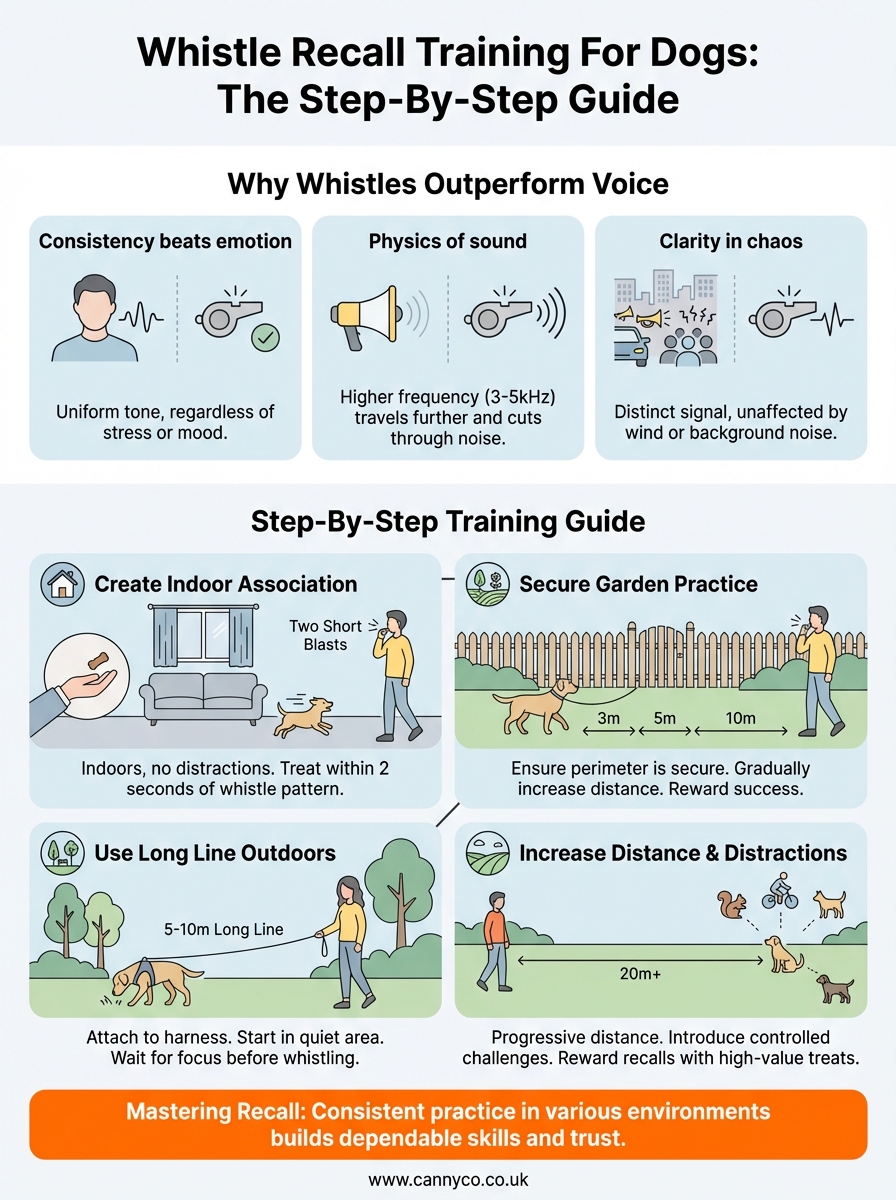
Your voice changes constantly. When you're stressed, tired, or frustrated, your tone shifts. Your dog hears these variations and might hesitate or ignore you entirely because the command sounds different each time. A whistle eliminates this problem by producing the exact same sound every single time you blow it, regardless of your emotional state.
Consistency beats emotion
Dogs respond to patterns, and whistle recall training for dogs creates a pattern your dog can trust. Your verbal recall might sound cheerful on Monday morning but strained and harsh after a long work day. This inconsistency confuses your dog because they're trying to interpret not just the command but your emotional state. A whistle removes emotional variables from the equation. The pitch, duration, and tone stay identical whether you're calm, panicked, or somewhere in between.
The whistle becomes a clear, unemotional signal that your dog learns to associate with a specific action, making training faster and more reliable.
Another person in your household can use the same whistle with identical results. Your partner, children, or dog walker can all achieve the same recall response because the whistle doesn't carry individual voice characteristics. This creates universal consistency across everyone who handles your dog.
Physics of sound
Whistles operate at higher frequencies than human voices, typically between 3,000 and 5,000 Hz. These frequencies travel further through open air and penetrate background noise more effectively. Your voice, especially when you're shouting, sits around 500 to 2,000 Hz and gets absorbed or drowned out by environmental sounds.
Distance matters during recall training. Your whistle carries up to 400 metres in open conditions, while your voice rarely exceeds 100 metres before becoming unintelligible. This extended range gives you control in large parks, fields, or beaches where your dog might wander beyond vocal range.
Clarity in chaos
Urban environments present constant noise pollution. Traffic, construction, other dogs, and people talking all compete with your voice. A whistle cuts through this chaos because its distinct frequency stands out from the ambient noise spectrum. Your dog's ears naturally pick up and focus on this sharp, penetrating tone even when surrounded by distractions.
Wind destroys vocal commands. Try shouting into a strong wind and notice how your words scatter and lose clarity. A whistle blast maintains its integrity regardless of wind direction or speed, ensuring your dog receives a clean signal every time.
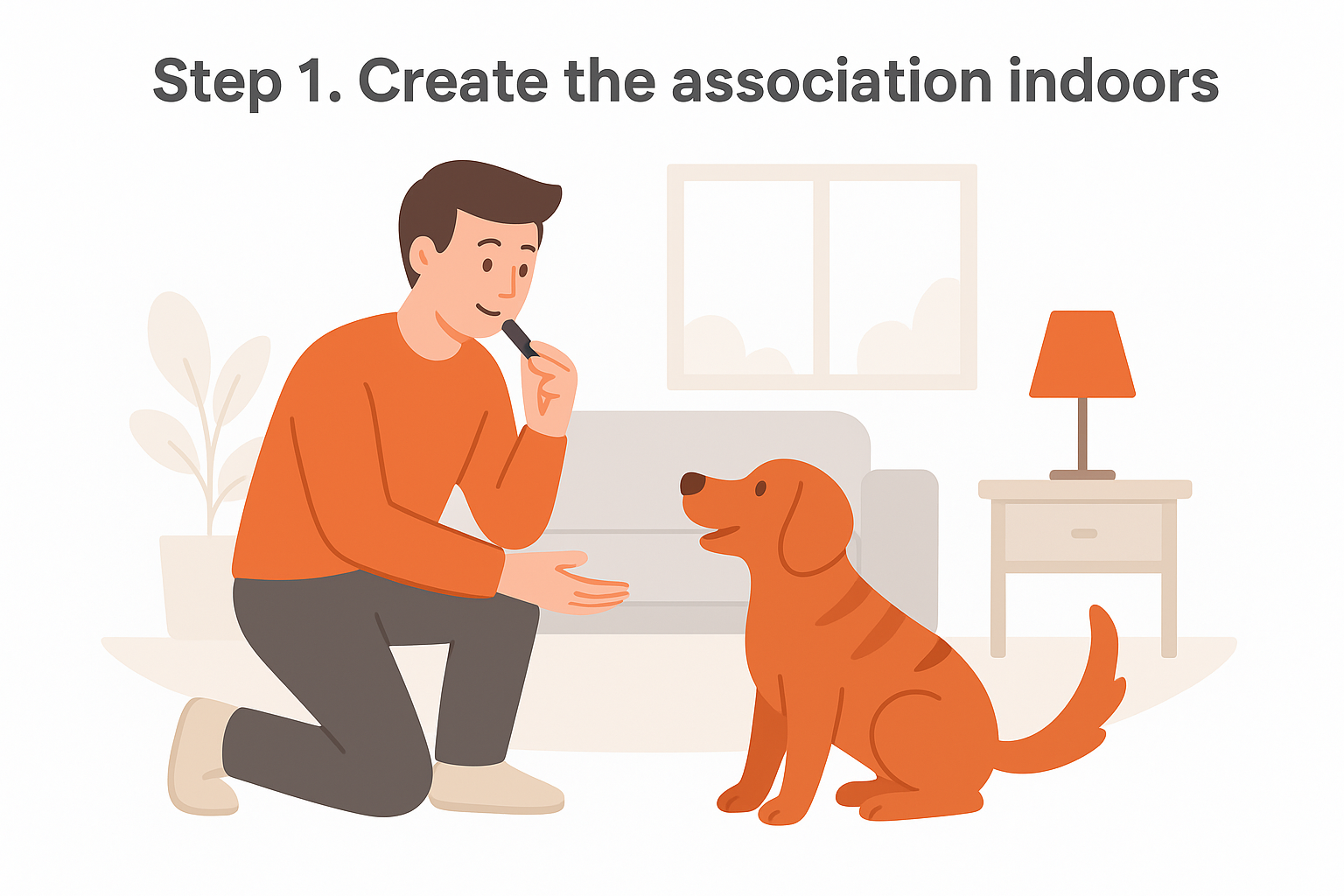
Step 1. Create the association indoors
Start whistle recall training for dogs in your living room or kitchen, away from distractions. This controlled environment allows your dog to focus entirely on the new sound and the behaviour you're teaching. Windows closed, television off, and other pets in a different room gives you the clean slate needed for effective learning.
Choose your whistle pattern
Select a distinct pattern that you'll use every single time. Two short blasts works well for most dogs, but you can use three quick bursts or one long blast instead. The pattern matters less than your consistency. Write down your chosen pattern and stick to it throughout training and beyond.
Never vary this pattern once you've established it. Your dog builds a mental connection between that specific sound sequence and the action of coming to you. Changing it later forces your dog to learn a completely new signal.
Consistency in your whistle pattern creates a reliable trigger that your dog recognises instantly, even years after initial training.
The reward system
Hold high-value treats in your pocket before you blow the whistle. Chicken, cheese, or liver treats work better than standard kibble because the reward needs to be exceptional. Blow your chosen pattern, and the instant your dog looks at you or takes a step towards you, deliver the treat.
Timing decides success. The treat must arrive within two seconds of the whistle sound. This tight timing window creates the association between whistle and reward. Your dog learns that the whistle predicts something excellent happening.
Repeat this sequence fifteen to twenty times per session, twice daily. Keep sessions under five minutes to maintain your dog's enthusiasm. Stop while your dog still wants more rather than pushing until they lose interest.
Step 2. Practice in a secure garden
Your dog now understands the whistle means good things happen indoors. Moving to your garden introduces new variables like outdoor smells, sounds, and visual distractions whilst maintaining a controlled environment. This intermediate step prevents the common mistake of jumping straight to open spaces where your dog might ignore the whistle and run off.
Secure the perimeter first
Walk your garden boundaries before starting. Check for gaps in fences, loose gate latches, or holes where your dog could escape. A single opening undermines the entire session because your dog learns they can ignore the whistle and still access freedom. Repair any weak points before you blow that whistle.
Remove or secure items that might distract your dog. Toys, balls, or gardening equipment create competing interests that dilute your whistle's value. You want your dog's full attention on the training, not on chasing a football across the lawn.
Start close, move further
Begin three metres apart. Blow your whistle pattern, and when your dog reaches you, deliver the treat and enthusiastic praise. Repeat this five times at the same distance before increasing to five metres. This gradual progression builds solid foundations rather than rushing to impress yourself.
Your dog needs to succeed repeatedly at each distance before you add more space, creating confidence in the recall behaviour.
Progress to ten metres once your dog consistently responds at five. Mix up your position in the garden so your dog learns the whistle works everywhere, not just in one spot. Call from the patio, then the shed, then near the fence. This variation teaches your dog that whistle recall training for dogs applies universally, not just in specific locations.
Practice for ten minutes maximum per session, twice daily. Stop when your dog still wants more rather than when they're bored or tired.
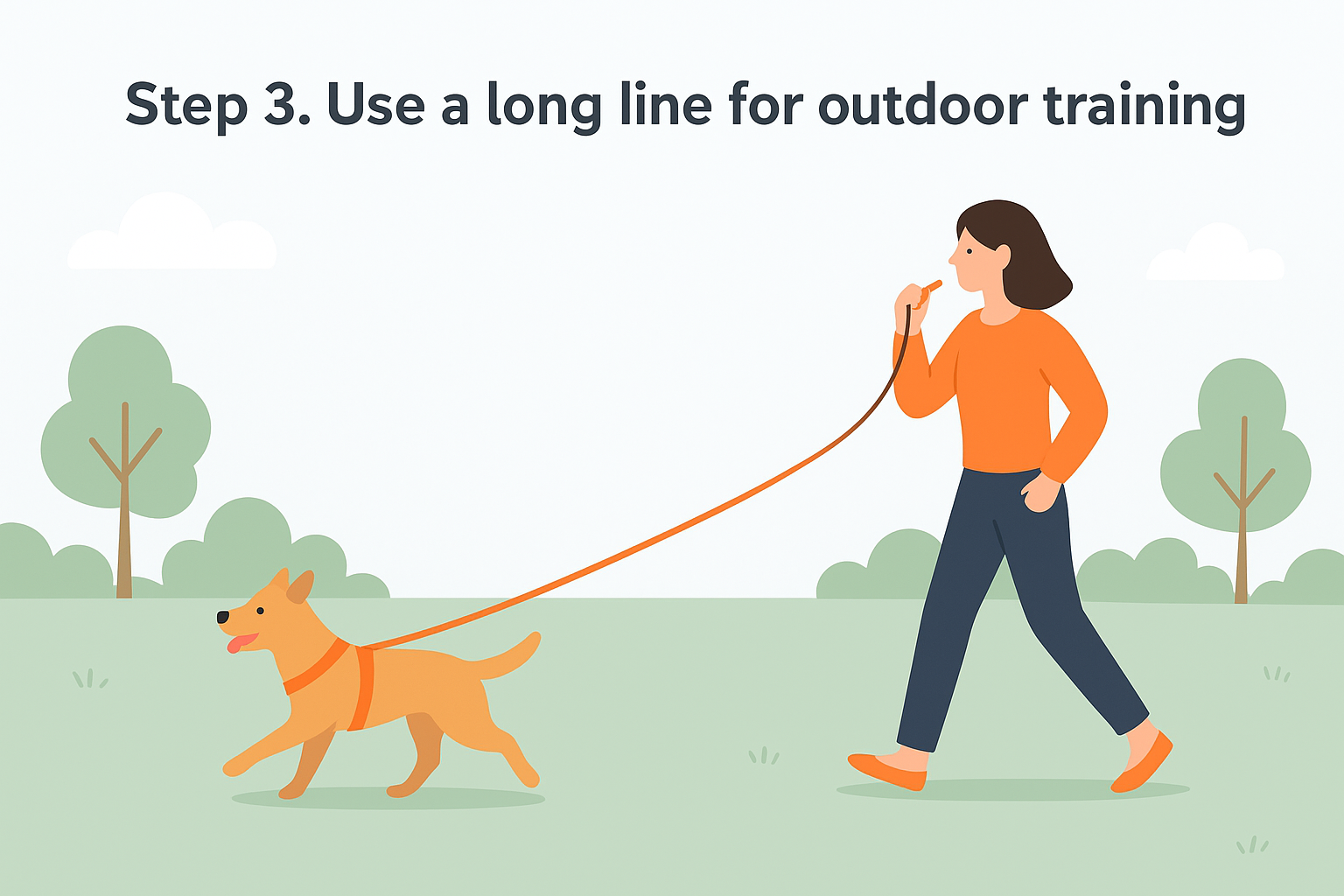
Step 3. Use a long line for outdoor training
Your garden success doesn't translate automatically to public spaces. Taking your dog to a park and hoping the whistle works sets you up for failure because the distraction levels jump dramatically. A long line bridges this gap by giving your dog freedom to explore whilst keeping you in control if they ignore the whistle.
Choose the right equipment
Purchase a five to ten metre training line made from lightweight material. Heavy ropes drag on the ground and tire your dog, reducing their willingness to respond. Look for lines with a comfortable handle and secure clip that won't detach during unexpected lunges.
Attach the line to a harness, not a collar. If your dog bolts and you need to stop them, the line's sudden tension distributes across their chest rather than their neck. This protects their throat and prevents the negative association between the whistle and physical discomfort.
Start in quiet locations first
Select an empty field or quiet park during off-peak hours. Early mornings on weekdays offer the lowest distraction levels. You need spaces where other dogs, cyclists, and joggers won't interrupt your training before your dog builds a solid outdoor response.
Let your dog sniff around whilst trailing the line. After thirty seconds of exploration, blow your whistle pattern. Your dog might hesitate or look around first, which differs from their garden response. Wait. Give them five seconds to process the sound in this new environment before repeating once.
The long line provides insurance whilst your dog learns that whistle recall training for dogs applies everywhere, not just at home.
When your dog comes, reward generously. Use your best treats and celebrate their success. Practice ten recalls per session, always ending on a positive response rather than a failure.
Step 4. Increase distance and distractions
Your dog responds reliably on the long line in quiet spaces. Now you systematically increase both distance and distractions without overwhelming them. This stage transforms their conditional response into a dependable skill that works regardless of what's happening around them.
Progressive distance training
Extend the line to its full length and walk to the opposite end. Your dog explores freely whilst the line provides backup control. Blow your whistle pattern when your dog isn't looking directly at you, testing whether they respond even when distracted by sniffing or watching birds.
Measure your success by response time. Your dog should turn and start moving towards you within three seconds of hearing the whistle. Anything longer indicates you've progressed too quickly. Drop back to shorter distances until their response sharpens again.
Practice whistle recall training for dogs at twenty metres in different locations. Parks, beaches, and woodland trails each present unique scents and sounds that challenge your dog's focus. Successfully recalling from twenty metres in three different environments proves your dog understands the command applies universally.
Testing recall across various environments builds the generalisation your dog needs to respond anywhere, not just in familiar training spots.
Adding controlled distractions
Introduce specific challenges one at a time:
- Other dogs playing thirty metres away
- People walking past with shopping bags
- Joggers and cyclists on nearby paths
- Birds or squirrels in the vicinity
- Food or toys visible on the ground
Start with the lowest-level distraction and recall your dog before they become completely absorbed. Success means recalling your dog whilst they're aware of the distraction but haven't fully committed to investigating it. Reward these recalls with your absolute best treats because they're significantly harder than recalls without competing interests.
Mastering the recall
Your dog's whistle recall journey progresses from indoor associations to reliable outdoor responses. The four-step process builds confidence through consistent practice, starting in controlled environments and gradually adding distance and distractions. This systematic approach prevents the failures that come from rushing to off-lead freedom before your dog's ready.
Maintenance matters after you achieve success. Practice whistle recall training for dogs weekly even when your dog responds perfectly. Skills deteriorate without regular reinforcement, and monthly practice sessions in different locations keep the behaviour sharp. Reward every recall with treats or praise to maintain your dog's enthusiasm for responding.
Walking your dog becomes genuinely enjoyable when you trust their recall. Having the right equipment makes training sessions more effective and safer. Browse our range of training leads designed specifically for recall training, including long lines that give your dog freedom whilst you build their response to the whistle.

